Plastic doesn't disappear. It moves.
What we throw away rarely stays where we left it. Plastic waste migrates — from bins into streets, from streets into drains, from drains into rivers, and from rivers into the ocean. It breaks into micro-particles that enter the food chain, the water we drink, and the air we breathe.
In Hyderabad and across India's urban centres, the challenge is acute. Collection systems are fragmented, and informal recyclers — who form the backbone of recovery — operate without fair wages, safety equipment, or recognition.
of plastic ever made has not been recycled; most ends up in landfills or the environment
Source: OECDof plastic enters the ocean every year — equivalent to a garbage truck every minute
Source: IUCNThe loop, up close
Four stages that turn waste into worth — anchored, audited, and scaled every year.
Collect
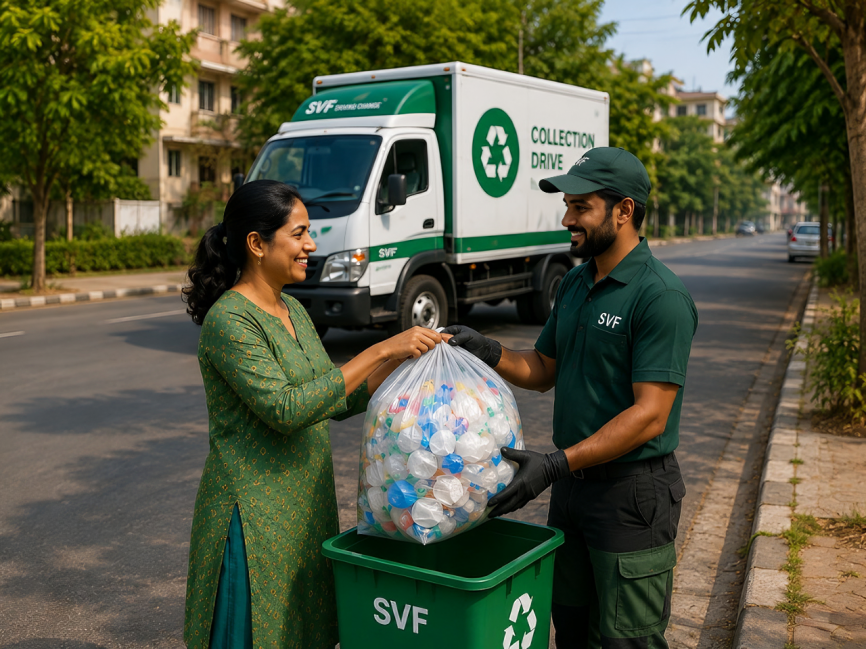
Collection is the most critical link in the chain. Without a reliable upstream, the entire loop breaks. SVF operates 300+ drop points across Hyderabad and surrounding peri-urban areas, supported by route-optimised collection vehicles that minimise fuel use and maximise coverage.
Households and businesses can schedule pickups through our mobile app — a simple interface that connects waste generators directly to the collection network. Every item is logged, weighed, and tagged before entering the system.
- 300+ community drop points across 64 localities
- Route-optimised fleet — 24 scheduled collection routes
- App-scheduled pickup for households & businesses
Sort
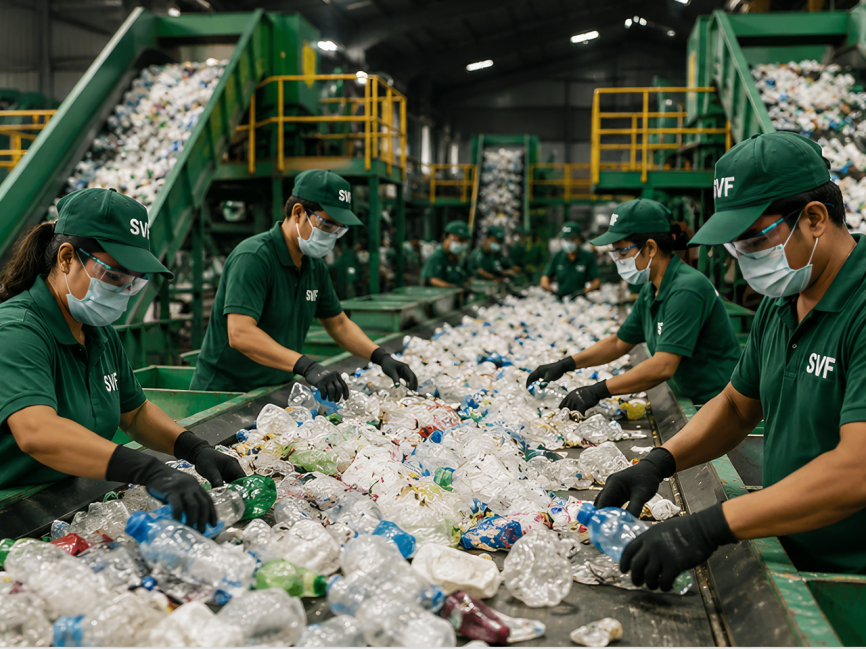
Once collected, materials arrive at our Material Recovery Facility (MRF) where they are separated by polymer type, colour, and quality. This step determines the economic value of the output — clean, well-sorted plastic commands a significantly higher price from manufacturers.
Our MRF uses a combination of manual sorting (which preserves jobs for informal workers) and mechanical separation for high-volume streams. Each batch is graded for purity before moving to the recycling stage.
- Separation by polymer — PET, HDPE, PP, LDPE, and mixed
- Cleaning and contaminant removal to food-grade standard
- Quality grading (A/B/C) with batch traceability
Recycle
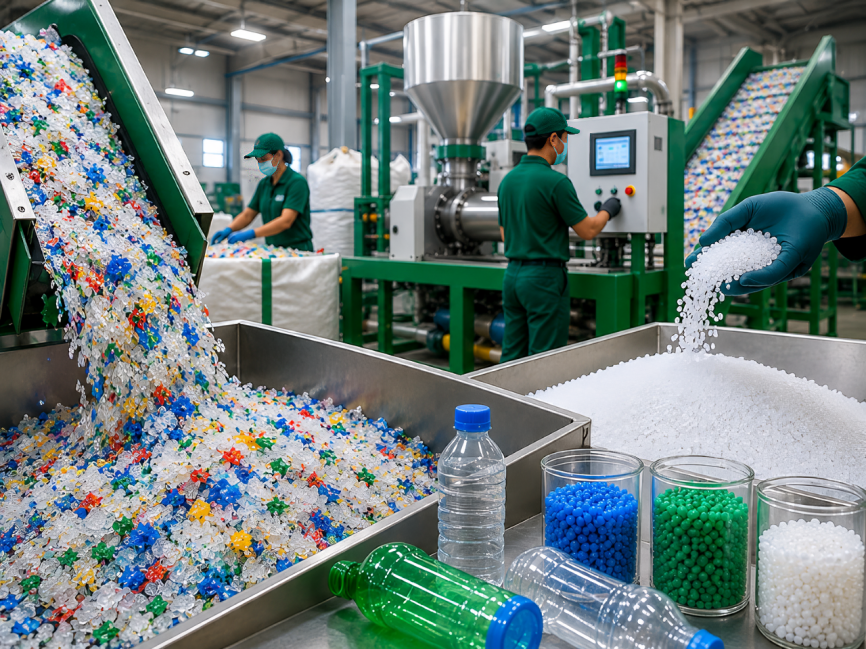
In the recycling stage, sorted plastic is shredded, washed, and extruded into high-grade recycled pellets (rPET, rHDPE, rPP). These pellets are sold to manufacturers as drop-in feedstock for new products — bottles, packaging, industrial sheeting, and more.
Our process achieves a 92% material recovery rate, meaning nearly every kilogram that enters the facility leaves as a usable product. The remaining 8% — non-recyclable fractions — is directed to co-processing in cement kilns where it displaces fossil fuel.
- Shred → wash (hot & cold) → dry → pelletise
- Food-grade rPET for new bottle production
- Zero process water discharge — closed-loop water system
Regenerate
Regeneration is what makes SVF different from a conventional recycler. Revenue from pellet sales funds two things: fair wages and social security for the informal recyclers who power the collection network, and restoration of the natural ecosystems affected by plastic leakage.
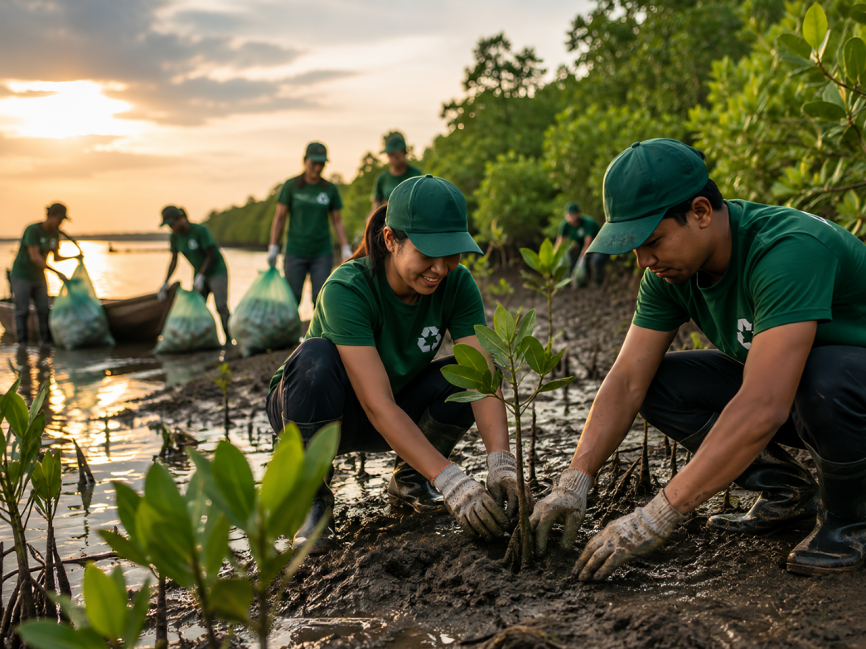
Our mangrove restoration programme along the Andhra coast directly offsets the environmental cost of plastic that escapes collection. Every tonne of plastic we sell funds the planting of 50 mangrove saplings. It is a reinvestment loop — not charity, but economics with accountability.
- Fair wages + social security for 640+ informal recyclers
- Mangrove restoration: 50 saplings funded per tonne sold
- Riverbank clean-up drives in 12 high-leakage zones
Materials we recover
Each polymer type has a dedicated processing stream to maximise purity and economic value.
Bottles, food trays, polyester fabrics
New bottles, strapping, textile fibre
Shampoo bottles, milk jugs, pipes
Pipes, buckets, detergent bottles
Food containers, straws, bottle caps
Auto parts, battery cases, brushes
Plastic bags, shrink wrap, squeezable bottles
Bin liners, packaging film, compost bags
Multi-layer packaging, composite materials
Co-processing fuel, industrial boards
Goal pathway
Three milestones live, one in sight — a clear route to zero landfill.
Who it helps
The loop touches lives at every link in the chain.
Children & schools
Plastic-free campuses, awareness workshops, and safe drinking water for communities around our collection points.
Learn moreRecyclers & families
Fair wages, safety equipment, health insurance, and skills training for the informal recyclers in our network.
Learn moreRivers & coastlines
Less plastic leakage means cleaner rivers, restored mangroves, and protected marine biodiversity along the Andhra coast.
Learn moreBecome a Plastic Warrior for 2 minutes
Turn a coffee break into cleaner oceans. Every level cleared funds real plastic collection.